
Let’s Prioritize Engagement Over Attendance
RTO mandates don’t fix the real leadership challenge

A recent Fast Company article puts a staggering number on the global employee engagement problem: $10 trillion in lost productivity, equivalent to roughly 9% of global GDP. Yikes!
The piece cited Gallup data showing that, globally, only 20% of employees were engaged at work in 2025, meaning four out of five people were either not engaged or actively disengaged. Double yikes! Even more concerning: this is down from 23% in 2023, which tells us this trend continues to head in the wrong direction.
It’s tempting to connect that decline to remote and hybrid work, but the numbers don't support such a simple conclusion. Gallup’s data found that exclusively remote employees were actually the most engaged group, at 31%, compared with 23% for hybrid and remote-capable on-site employees.
While the return to office can’t be blamed for engagement, the recent rise in RTO mandates and the blowback they’ve received highlight the kind of leadership needed to build the engagement that drives performance.
Attendance can be mandated. Engagement can’t.
Is this about engagement or control?
Adam Grant, Marissa Shandell and Courtney Elliott recently wrote a provocative New York Times Opinion piece based on six years of research into leaders’ attitudes toward remote work.
The piece cites a 2025 Flex Report by Work Forward, which states that a third of U.S. companies have forced everyone back to the office full-time and banned remote and hybrid work.
“Some leaders say they insist on full-time in-person work because it boosts productivity, despite clear evidence that it does not,” they write. “Others claim it’s about collaboration, creativity or culture.”
Their research shows something else: the personality trait that consistently predicted opposition to remote work was narcissism. Leaders with higher self-regard were more likely to value power and status and to favour RTO mandates.
To be clear, that doesn’t mean every leader who wants people in an office is a narcissist. There are legitimate operational, cultural, and human reasons to work together in person.
But the research should prompt leaders to be honest with themselves. Is having people where you can see them more about your needs or the company’s? And how might that be hurting employee engagement, which is so vital to building a productive, positive team?
I’ve seen this in my own clients. I worked with an organization that introduced a rigid office policy without any clear work-related rationale and, critically, without really listening to the people it affected. The policy may have succeeded in getting people into the office. But it also eroded engagement.
That’s the difference between command-and-control leadership and leadership built on caring and trust
From compliance to commitment
One of WhiteWater’s guiding ideas about leadership is that it is most effective when built on caring, curiosity, and courage. Without these traits, you might still get compliance, but you don’t necessarily get engagement. This isn’t just about being “nice.” It poses real business risks.
As Fast Company notes, highly engaged teams see 18% higher productivity, 23% higher profitability, and up to 43% lower turnover.
When people feel genuinely cared for, when leaders are curious about their experience, listen to them and demonstrate trust, a flywheel starts to whir: connection creates trust, trust fuels engagement, and engagement moves people beyond compliance toward commitment. This is the place where discretionary effort lives: the ideas people volunteer, the problems they solve without being asked, the colleagues they stop to help, the extra bit of themselves they choose to bring to the work.
No policy, for RTO or anything else, can mandate that. And no amount of office redesign, free lunch, or Friday drinks can manufacture it if the underlying leadership experience reflects a lack of trust or care.
Focus on outcomes, not mechanics
It’s important to note that there are good reasons to bring people together in person. There’s something special about IRL collaboration, problem-solving, and learning. There are aspects of face-to-face interaction that can’t really be replicated over Zoom or Slack.
But those don’t happen automatically because everyone swipes in at the office. Attendance shouldn’t be our primary measure of success, but rather the value the workplace experience adds.
We talk a lot at WhiteWater about the connection between strategy and execution. You can have a brilliant strategy, but ultimately it has to become real through thousands of everyday actions throughout an organization. Engagement works the same way. It’s all of those small choices and actions that build it.
We recently had a client conversation about large company meetings that bring hundreds of people together. These events require an enormous investment of time, travel, energy and money. What is the purpose? What outcomes do we expect? Is bringing everyone together the best way to achieve them? How does this connect to the organization’s strategy?
It all comes down to being much clearer about why we bring people together; what happens when we're together that makes us better? The same questions apply to RTO.
Design for engagement, not attendance
I’m less interested in debating whether remote, hybrid, or in-office work is best than in whether leaders are being intentional about engagement.
That means doing the hard, human work of ensuring we answer these questions: Do people understand where our organization is going and how their work contributes to it? Do they feel trusted and seen? Are we genuinely listening to them? Are we creating opportunities for meaningful connection? Do our meetings and operating mechanisms help people do better work, or simply consume their time?
And if we want people together, we need to clearly and honestly articulate why. That way, time together is valuable. Let's create opportunities for connection, learning and collaboration that are genuinely better because we're together. And let's measure the outcomes that actually matter rather than confusing presence with performance.
The $10 trillion engagement problem won’t be solved by a butt-in-chair mandate, but by giving your people something worth engaging in.
Ready to Strengthen the Conversations That Drive Engagement?
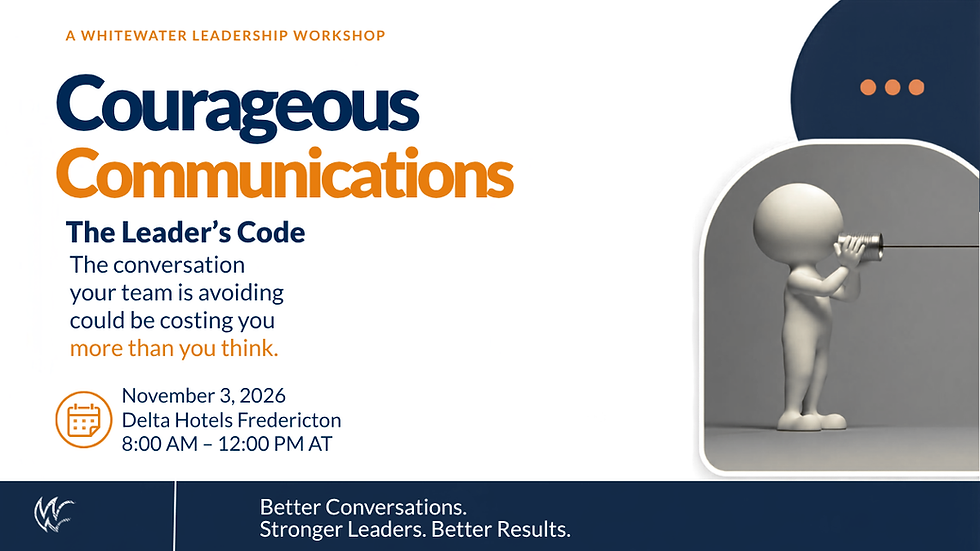
Join us for Courageous Communications – The Leader’s Code, a practical half-day workshop designed to help leaders communicate with greater clarity, confidence, and empathy.
📅 November 3, 2026 | 8:00 AM–12:00 PM📍 Delta Fredericton, Fredericton, NB
Early Bird: $139 — available until the end of September.



Comments